Indica Festivals 2026
The term "Utsab" typically denotes a festival or celebration, particularly within the framework of Indian culture. It originates from the Sanskrit word "utsava," which encompasses meanings such as "to rejoice," "to uplift," "to experience happiness," or "to celebrate." Thus, "utsab" effectively embodies any occasion or event characterised by joyfulness. Among the numerous religious festivals observed, one prominent example is the Holi festival of colours, celebrated annually in March.

March 4th 2026
Holi Festival
Holi, the Festival of Colors, is a vibrant Hindu festival celebrating spring, love, and the triumph of good over evil, marked by people joyfully throwing colored powders (gulal) and water at each other, symbolizing new beginnings and unity.
Celebrated with bonfires (Holika Dahan) the night before and widespread color play the next day (Rangwali Holi), it's a joyous occasion for feasting, dancing, and breaking down social barriers, originating in India but celebrated globally.
The famous ancient Purana story of prince Prahlad and his evil father king Hiranyakashypu is depicted in our workshop, (see pic). The half man half lion avatara incarnation of Lord Vishnu also makes a special appearance in school.
May 1st 2026
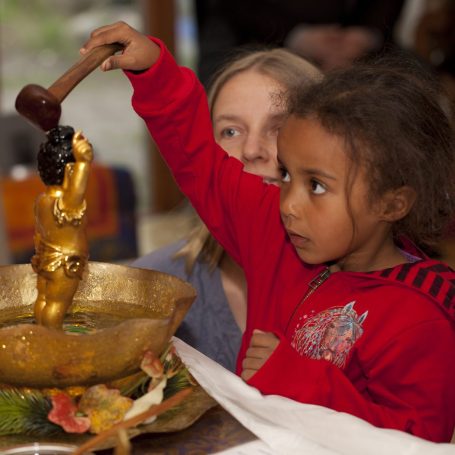
Wesak Festival
The term "Vesak" derives from the Pali word "vesākha" and the Sanskrit equivalent "vaiśākha," both signifying the lunar month of Vaisakha, which is recognised as the month that marks the birth of the Buddha.
In Mahayana Buddhist traditions, this occasion is acknowledged using its Sanskrit designation (Vaiśākha) alongside its various derived forms. On Vesak Day, Buddhists globally com-memorate pivotal events that are significant across all traditions, including the birth, enlightenment, and passing of Buddha Gautama.
As Buddhism expanded from India, it was integrated into a myriad of foreign cultures, resulting in diverse celebrations of Vesak worldwide. In India, the day of Vaishakh Purnima is also referred to as Buddha Jayanti and is traditionally observed as the birthday of the Buddha.
April 14th 2026
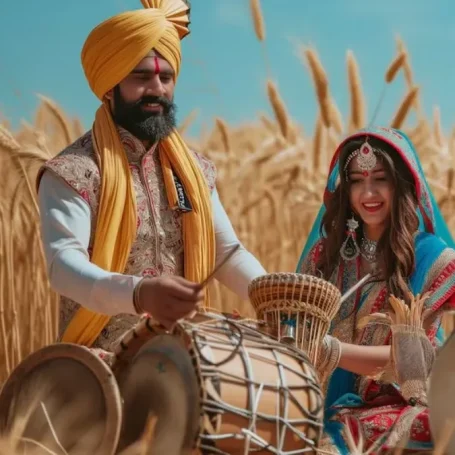
Vaisakhi Festival
Vaisakhi, alternatively spelled Baisakhi, holds considerable significance for both Hindus and Sikhs. It com-memorates the initiation of the Sikh New Year and the establishment of the Khalsa by Guru Gobind Singh in 1699.
For the Sikh community, this occasion serves as a time for celebration and reflection, typically characterised by vibrant processions known as Nagar Kirtan, the performance of devotional hymns (kirtan), and the communal sharing of food through Langar. Concurrently, Hindus observe Vaisakhi as a harvest festival, marked by visits to temples and participation in traditional rituals, such as bathing in sacred rivers.
March 26th 2026
Ramnavami Festival
Lord Rama is believed to have mani-fested on Earth several millennia ago during the Treta Yuga, specifically on the ninth day of the waxing moon in the month of Chaitra (March-April) according to the Hindu lunar calendar.
Each year, this day is commemorated by Hindus as Lord Rama's birthday, or “appearance day,” as he does not undergo birth in the manner of a mortal being.
The celebrations, which include Rama Navami puja rituals and the recitation of Shri Rama, occur in the hours leading up to noon, culminating at precisely 12.00 noon, marking the moment of the Lord’s divine appearance.
A Typical Diwali Workshop
The children enjoy dressing up as characters from ancient history. Here they are dressed as Sita and Rama along with his brother laxman and faithful servant, the monkey king Hanuman.